
WooCommerce vs Shopify in 2026: the honest cost and control breakdown
Every few weeks the debate flares up again: a store owner posts that they have finally moved from WooCommerce to Shopify (or back the other way), and the replies split into two camps that talk straight past each other.
Here is the thing the arguments usually miss: stores are switching in both directions, constantly. In Store Leads' most recent trailing 90-day migration window (data checked 15 July 2026), 9,453 stores moved from WooCommerce to Shopify and 4,002 moved from Shopify to WooCommerce. Neither platform is dying. People are choosing different trade-offs.
Full disclosure before we start: Wordify is a managed WordPress host, and WooCommerce stores run on our infrastructure every day. So you know where we sit. But this is written as the comparison we would want to read ourselves: real prices from both companies' own pages, checked on 15 July 2026, and honest credit where Shopify genuinely wins.
The short version
- Shopify sells you a finished store as a subscription. Setup is fast, everything is handled, and you pay for that convenience in monthly fees, app subscriptions, and payment rules that reward staying inside Shopify's ecosystem.
- WooCommerce gives you a free, open-source store you assemble and own. There are no platform fees and no revenue share, but hosting, maintenance, and performance are your responsibility (or your host's).
The real decision is not "which is cheaper?" so much as "who do you want in control?" The costs follow from that.
Two different deals
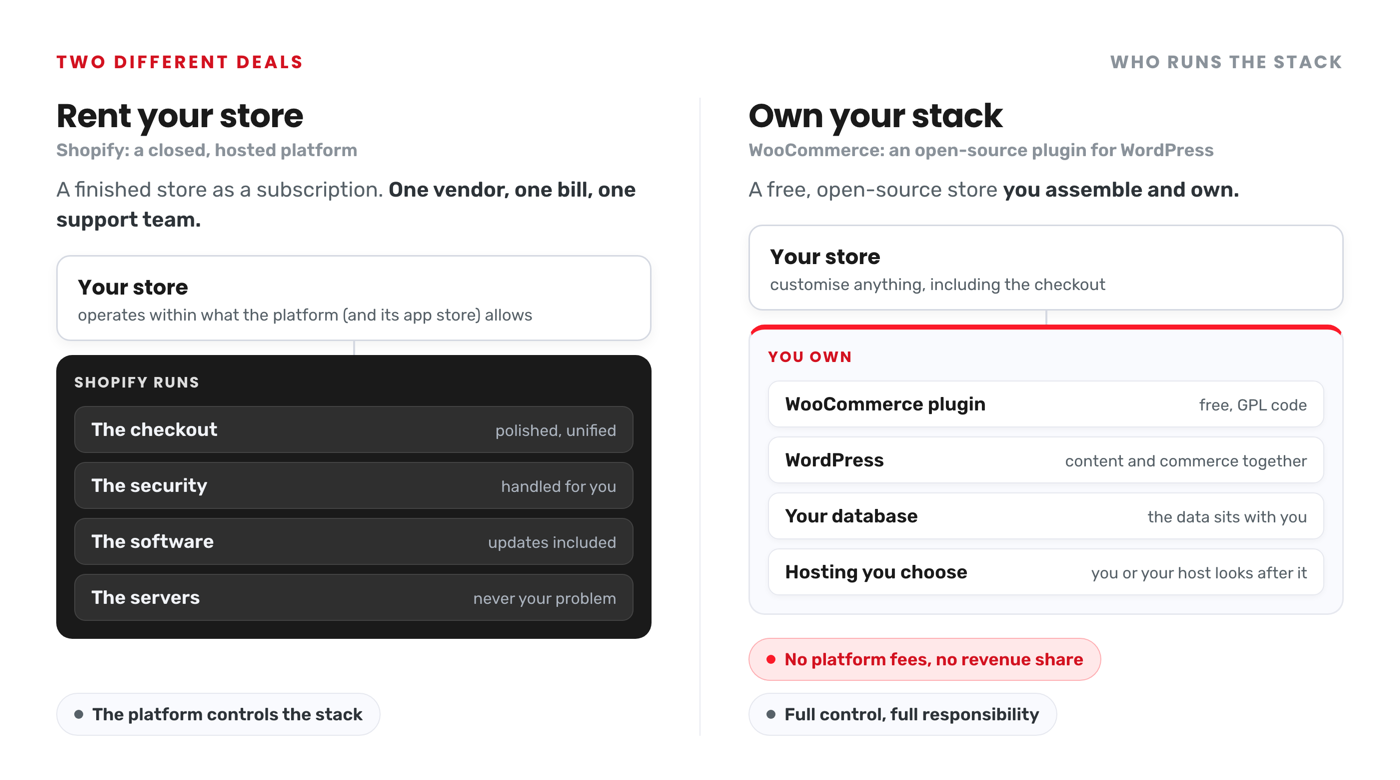
Shopify is a closed, hosted platform. You rent your store: Shopify runs the servers, the checkout, the security, and the software, and you operate within what the platform (and its app store) allows. That constraint is also the appeal. There is one vendor, one bill, and one support team, and it all just works.
WooCommerce is an open-source plugin that turns WordPress into a store. You own the whole stack: the code is GPL, the data sits in your own database, and you can customise anything, including the checkout. WooCommerce's own pitch is "full control: of your checkout, your data, your costs". The flip side is that "full control" also means full responsibility.
Everything below (pricing, fees, market share) flows from that structural difference.
What Shopify costs in 2026
Shopify's standard plans, on monthly billing, as published by Shopify (checked 15 July 2026):
| Plan | Monthly price (USD) | Third-party payment fee |
|---|---|---|
| Basic | $39 | 2% |
| Grow | $105 | 1% |
| Advanced | $399 | 0.6% |
| Plus | from $2,300 | 0.2% |
For Australian merchants, Shopify's local pricing is A$56 (Basic), A$149 (Grow), and A$575 (Advanced) per month on monthly billing, with Plus starting at A$3,700 per month.
Two costs sit on top of the subscription:
- Payment processing. Shopify Payments card rates vary by plan, payment method, and region; Shopify puts the range at roughly 2.4% to 3.5% per transaction. Every platform has processing costs, so this one is not unique to Shopify.
- The third-party payment fee. This one is unique to Shopify. If you use a payment provider other than Shopify Payments, Shopify charges an additional fee on every sale: 2% on Basic, down to 0.2% on Plus. It is a platform fee for not using Shopify's processor, and it is the clearest example of how a closed platform prices its control.
Apps are the other recurring line. Many stores need paid apps for functionality WordPress users would expect from a plugin, and those subscriptions add up. We have not priced a "typical" app stack here because it varies too much to state honestly.
What WooCommerce costs in 2026
The WooCommerce core plugin is free, and WooCommerce charges no platform fees and no revenue share. But "the plugin is free" is not the same as "the store is free". Using WooCommerce's own cost guidance (checked 15 July 2026):
| Component | WooCommerce's own guidance |
|---|---|
| Core plugin | Free, open source |
| Hosting | $25 to $350/month for most stores |
| Extensions | $29 to $299/year per extension |
| WooPayments processing | ~2.50% to 2.90% + 30¢ per transaction |
| Platform fee / revenue share | $0, 0% |
So a lean WooCommerce store runs on hosting plus a handful of extension licences, and processing costs land in the same band as everyone else's. The number that matters is the one that is missing: there is no line item that scales with your revenue.
Transaction fees: the line item that grows with you
Subscriptions are easy to compare. The fee that sneaks up on stores is the one charged as a percentage of sales.
Here is an illustrative example (our arithmetic, using the verified rates above). Say your store does $30,000 per month and you want to use a payment provider that is not the platform default:
- Shopify Basic: $39 subscription + 2% third-party fee ($600) = $639/month to Shopify, before your payment provider's own processing fees.
- WooCommerce: your hosting bill + $0 in platform fees, before the same processing fees.
You can avoid Shopify's third-party fee by using Shopify Payments, and for many stores that is a perfectly good answer. But that is exactly the point about control: on Shopify, using your preferred provider has a price. On WooCommerce, the choice of payment provider, like every other architectural choice, is yours without penalty.
At $5,000 per month, this barely matters. At $100,000 per month, it is the biggest number in the comparison.
Market share: what the numbers actually say
Market share gets quoted selectively by both camps, so here are the figures with their methodologies attached. They measure different things, which is why they disagree.
- W3Techs (surveys detected technologies across all websites, updated daily; checked 15 July 2026): WooCommerce is used by 48.6% of the e-commerce systems in its surveys, Shopify by 30.9%. This method counts every detectable site, including millions of very small ones.
- Store Leads (counts live stores using a heuristic that includes historical DNS data; Q3 2026): about 4.17 million live WooCommerce stores versus about 2.87 million live Shopify stores.
- WooCommerce itself cites Store Leads for a 31% share of the top one million e-commerce sites.
- By money moved, Shopify is enormous: its platform processed $378.4 billion in gross merchandise volume in 2025, up 29% year on year, per its own 10-K filing. Store Leads notes the average Shopify merchant transacts considerably more than the average WooCommerce merchant.
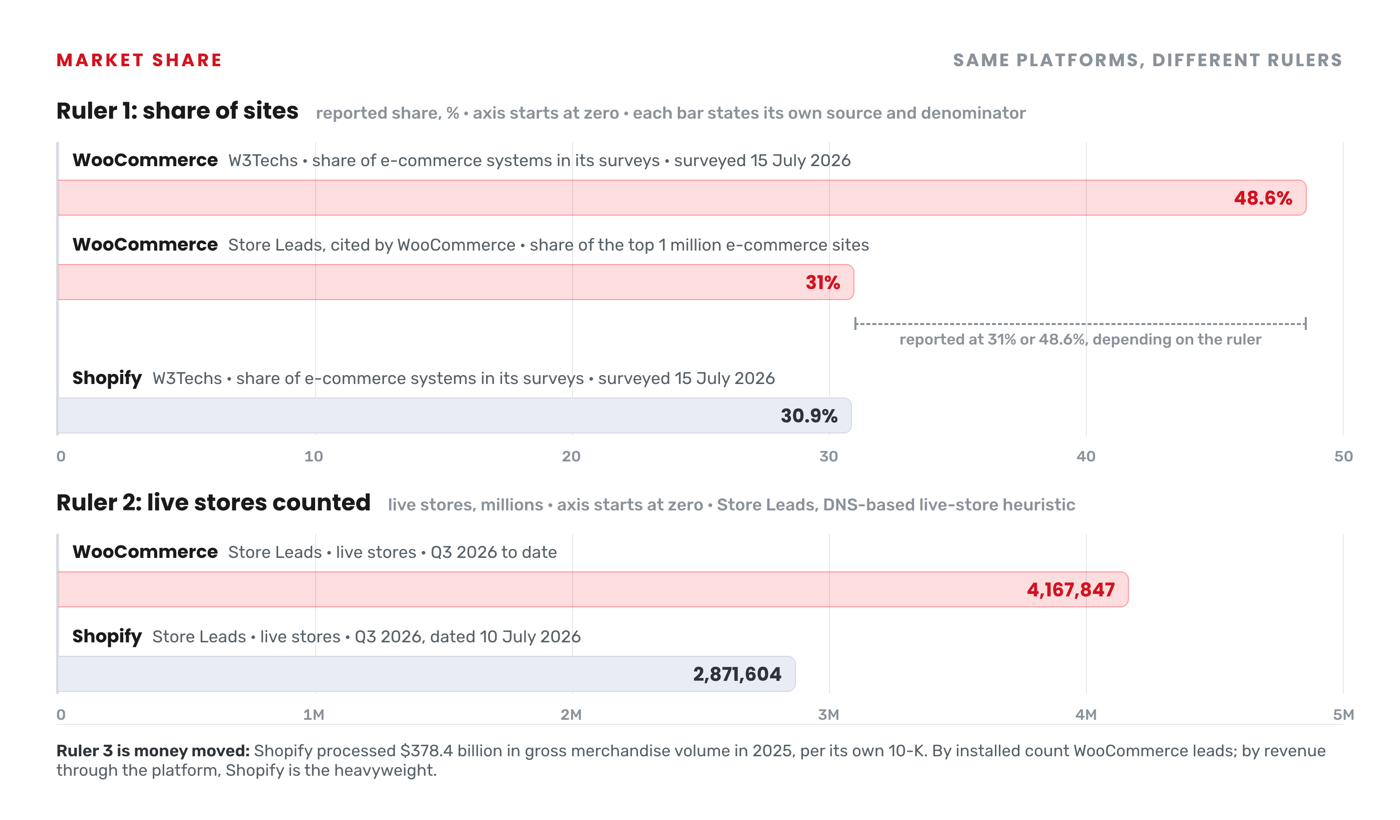
Honest summary: by installed count, WooCommerce leads. By revenue flowing through the platform, Shopify is the heavyweight. Any article that quotes only one of those numbers is selling you something.
Where Shopify genuinely wins
Credit where it is due, because this list is why 9,450 stores went that way last quarter:
- Everything in the box. Hosting, security, compliance, checkout, and updates are Shopify's problem, not yours. You will never think about a server.
- Speed to launch. A functional store in a day is realistic.
- A polished, unified checkout across a huge merchant network.
- One vendor. When something breaks, there is exactly one company to contact.
- Retail. If you sell heavily in person, Shopify's POS integration is a genuine advantage.
If you want a store the way you want electricity, on and someone else's problem, Shopify is a very good product and the subscription is the fair price of that.
Where WooCommerce genuinely wins
- Ownership. The code is open source and the data is in your database. If you outgrow your host, you take the entire store with you. There is no equivalent exit from a closed platform.
- No revenue share. 0% platform fees at any scale, with any payment provider.
- Unlimited customisation. The checkout, the data model, the integrations: all of it is editable. Agencies and developers can build exactly what the business needs.
- Content and commerce together. WooCommerce runs on WordPress, which powers 43% of the web (WooCommerce's citation of W3Techs). If content, SEO, and commerce belong in one place for you, this is the native way to do it.
- Costs you can restructure. Every line item (host, theme, extensions, payments) is competitive and swappable.
The honest catch: WooCommerce's biggest cost is operational
Look back at that migration data. When stores leave WooCommerce for Shopify, the reason is rarely the software. It is the operations: slow hosting, plugin conflicts, no one on call when checkout breaks at 2am. WooCommerce hands you control of the whole stack, and cheap hosting quietly hands the bill back as downtime and lost sales.
That gap is exactly what managed WordPress hosting exists to close. On Wordify, WooCommerce stores get the managed layer Shopify customers take for granted, without giving up the ownership: every plan includes a global CDN, WAF and malware scanning, SSL, backups, and 24/7 expert support, with a guaranteed one-hour human response. Our Business plan ($25/site/month) suits light WooCommerce stores, and Pro ($49/site/month) is built for high-traffic WooCommerce. All prices USD, current on 15 July 2026.
That is the fair framing of the whole debate: Shopify versus WooCommerce-on-good-hosting is a real contest of philosophies. Shopify versus WooCommerce-on-neglected-hosting is not, and it is where most of the horror stories come from.
So which one?
- Choose Shopify if you want the fastest path to selling, you are happy inside one ecosystem, and a subscription plus platform fees is a fair trade for never touching infrastructure.
- Choose WooCommerce if you want to own your store outright, keep 100% of your revenue free of platform fees, customise without permission, and either you or your host will look after the stack.
Both are good answers to different questions. Just decide on control first and cost second, because the cost structure follows from who is in control.
If WooCommerce is your answer, we will move your store for you: migrations are free, done by our team, and covered by our first-month money-back guarantee (cancel within your first month and we refund your service cost in full).
All pricing in this post was checked against the providers' own pages on 15 July 2026. Prices and fees change; verify current rates before making a decision.